
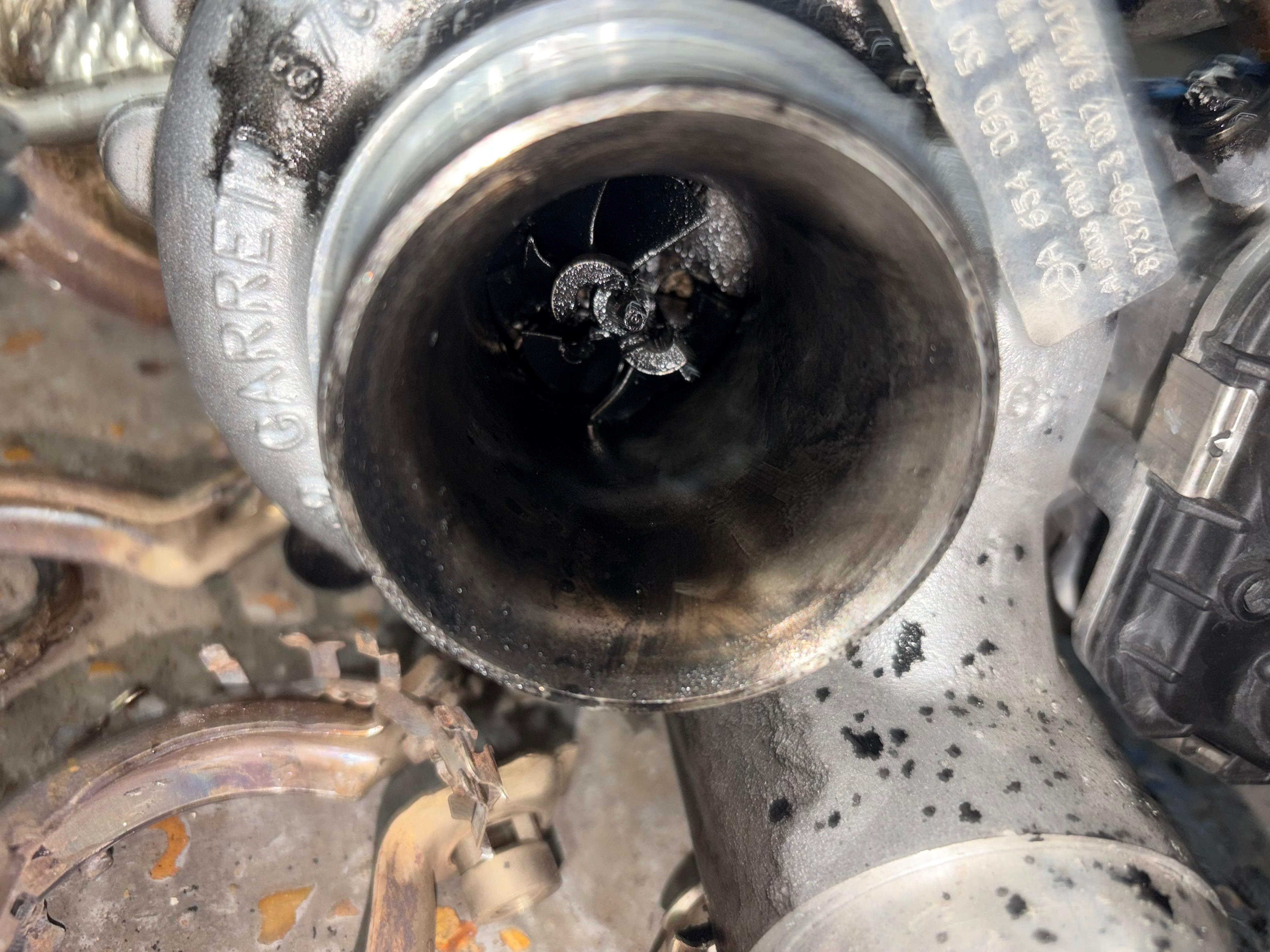

The turbo itself isn't necessarily weak - it's often manufactured by Garrett, a well-known and generally reliable manufacturer. The operating environment is what kills it.
The core reason: the OM654 turbo sits in a much hotter emissions layout
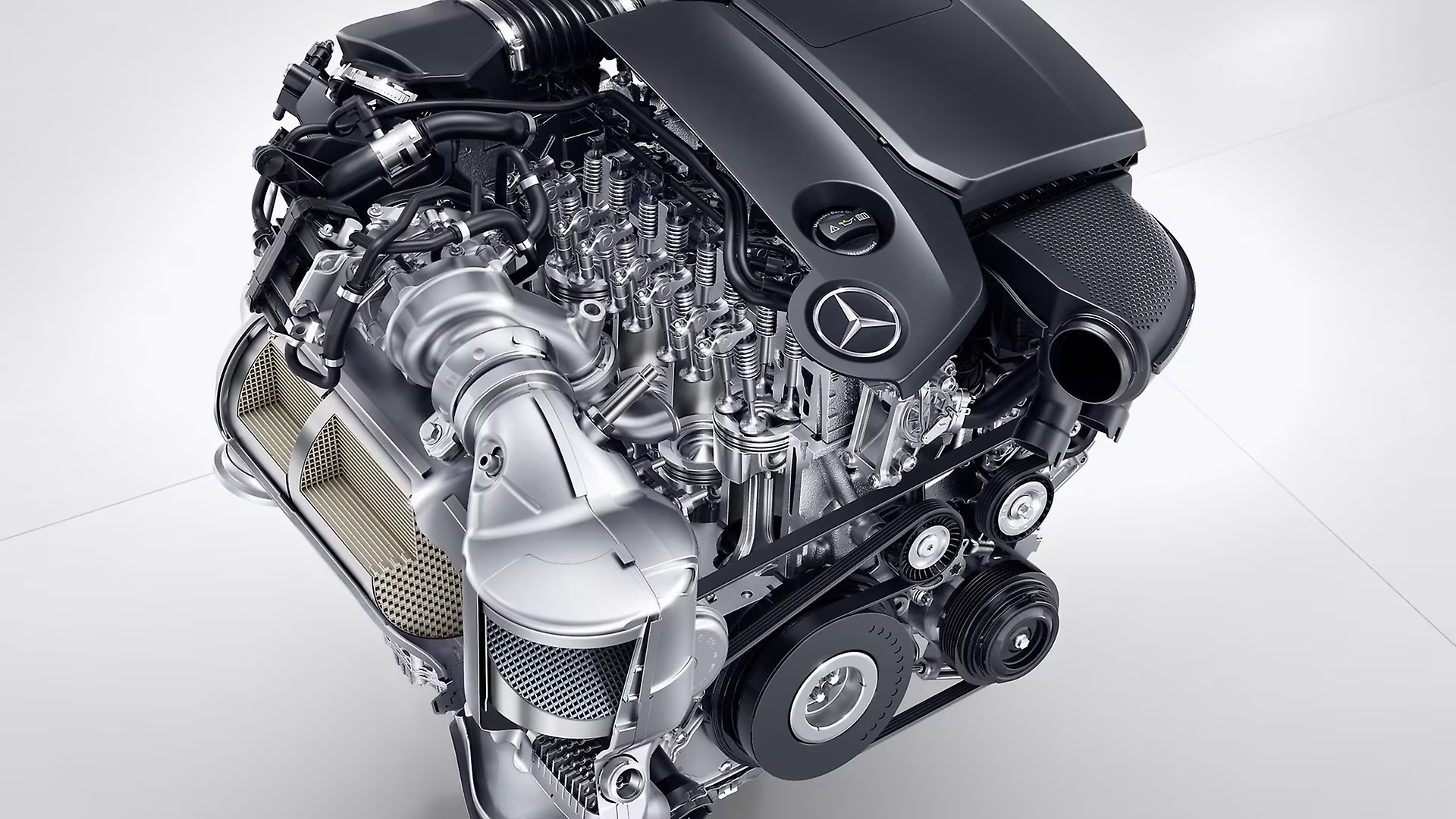
On the OM654, the aftertreatment layout is designed to stay hot and work fast - especially for modern Euro 6d/RDE targets. The close-coupled DOC followed by urea injection/mixing and a DPF/SCR unit means a compact "close to the engine" emissions system.
Close-coupled emissions system (DPF/cat directly below the turbo compared to OM651) → significantly higher turbo operating temperature.
That's great for emissions compliance. But it pushes more heat into the turbo's neighbourhood, and that heat has consequences.
Regeneration heat is the turbo's worst enemy (and vans trigger it more often)
DPF regeneration is basically the ECU intentionally raising exhaust temps to burn soot out of the filter. During active regen, typical target temperature is around 600-700°C.
Repeated regen cycles cause:
- Extreme turbo thermal cycling
- Bearing fatigue
- Oil breakdown
- Shaft distortion
And it's especially problematic in vans doing short trips, urban stop/start, and delivery work - which is exactly typical W907/W447 usage.
Lubrication breakdown: the silent killer
The turbo bearings live off a thin oil film. When the turbo runs hotter (and heat-soaks more), oil is more likely to degrade. Extended oil service intervals make this significantly worse.
That chain leads to: shaft play → seal control issues → oil migration → failure or seizure.

Single turbo design under commercial duty
The OM654 uses a single turbo doing all the work in a heavy van duty cycle. That means high average turbine load - especially when regen and high EGR/boost strategies are in play.
"It's not some no-name unit - the environment is killing it." Many OM654 Sprinter turbo listings are indeed Garrett-referenced by OE number.
Why OM651 turbos often lasted longer
The previous-generation OM651 had several advantages that helped turbo longevity:
- Lower exhaust temps (less thermal stress in the turbo area)
- Twin turbo load distribution / bigger single turbo design
- Less aggressive regen strategy
- More robust oil viscosity spec / oil change intervals (in many real-world fleets)
- Less tightly integrated emissions system
A major technical difference: OM651 high-output variants use dual-stage turbocharging (small high-pressure + large low-pressure turbo). The boost work is split across stages instead of one unit constantly eating everything.
Typical OM651 failure pattern (what we see):
- 60k-120k miles turbo failure window
- Often oil present in intake/intercooler
- Shaft play increasing before failure
- Frequently occurs with DPF/EGR issues
Why we're not seeing these failures as often in passenger cars
The W907 Sprinter and W447 Vito are particularly vulnerable because of:
- Heavy vehicle load
- Frequent stop/start driving
- Long idle times
- Frequent DPF regeneration
- Commercial duty cycle
Passenger cars generally see fewer failures because their duty cycle is usually kinder: fewer interrupted regens, less idling, more steady-state cruising.
Symptoms and failure modes: what owners actually notice
Symptoms: whining noise, loss of boost, oil in intake/intercooler.
Cause: oil breakdown and bearing wear.
If you catch it here, you're often saving the whole intake/emissions system from becoming an oil trap.

Symptoms: sudden loss of power, limp mode, no boost. In severe cases: non-start or major running issues if enough oil enters cylinders.
When cylinders fill with oil, the real risk is liquid ingestion / hydrolock - a known mechanism that can cause severe damage including bent connecting rods.


Why the closely integrated emissions system increases risk
Closely integrated emissions systems increase the risk of:
- Soot contamination entering the turbine housing
- Oil contamination from blow-by
- Carbon buildup affecting turbo seals
Also worsened by:
- Extended oil change intervals
- Low-viscosity oil spec (where the oil has less tolerance once heat degradation starts)
- Aggressive EGR use
- Higher boost pressures
- More frequent regen cycles
- Higher sustained turbine load
Repair costs: why early diagnosis is everything
Diagnosed before it becomes an oil-dump situation: as low as ~£1,500 for parts and labour to fit a remanufactured turbo (vehicle-dependent, access-dependent, assuming no extra faults).
If the turbo starts passing significant oil, it can contaminate:
- Charge air cooler (intercooler)
- Intake manifold
- EGR coolers / EGR tract
MAHLE specifically notes that after turbocharger damage, the charge air cooler must be checked and may need replacing - internal contamination can't always be removed reliably. In the worst cases, oil ingestion can lead to hydrolock-type damage including bent rods.
What can you do to reduce the risk?
If your interval is typically 2 years or 40,000 km, consider making it 1 year or 20,000 km - especially for urban/delivery vans.
This can reduce repeated heat-soak cycles and constant restart demand. (Trade-off: fuel economy.)
Short trips and interrupted regens are turbo punishment. A regular longer run helps the DPF complete regeneration cleanly and reduces repeated "attempted" regen cycles.
Final takeaway
The OM654 turbo failure issue is fundamentally caused by emissions-driven thermal stress + lubrication degradation - not a simple defective turbocharger.
Hearing whining, seeing oil in boost pipes, or getting underboost/limp mode on a W907 Sprinter or W447 Vito?
The best money you'll spend is a proper diagnostic before it escalates. Book a Standard Diagnosis - we cover all limp mode, emissions, and turbo-related faults in one visit.
Need help with this?
We offer professional diagnostics for these issues. Book a visit or WhatsApp us.